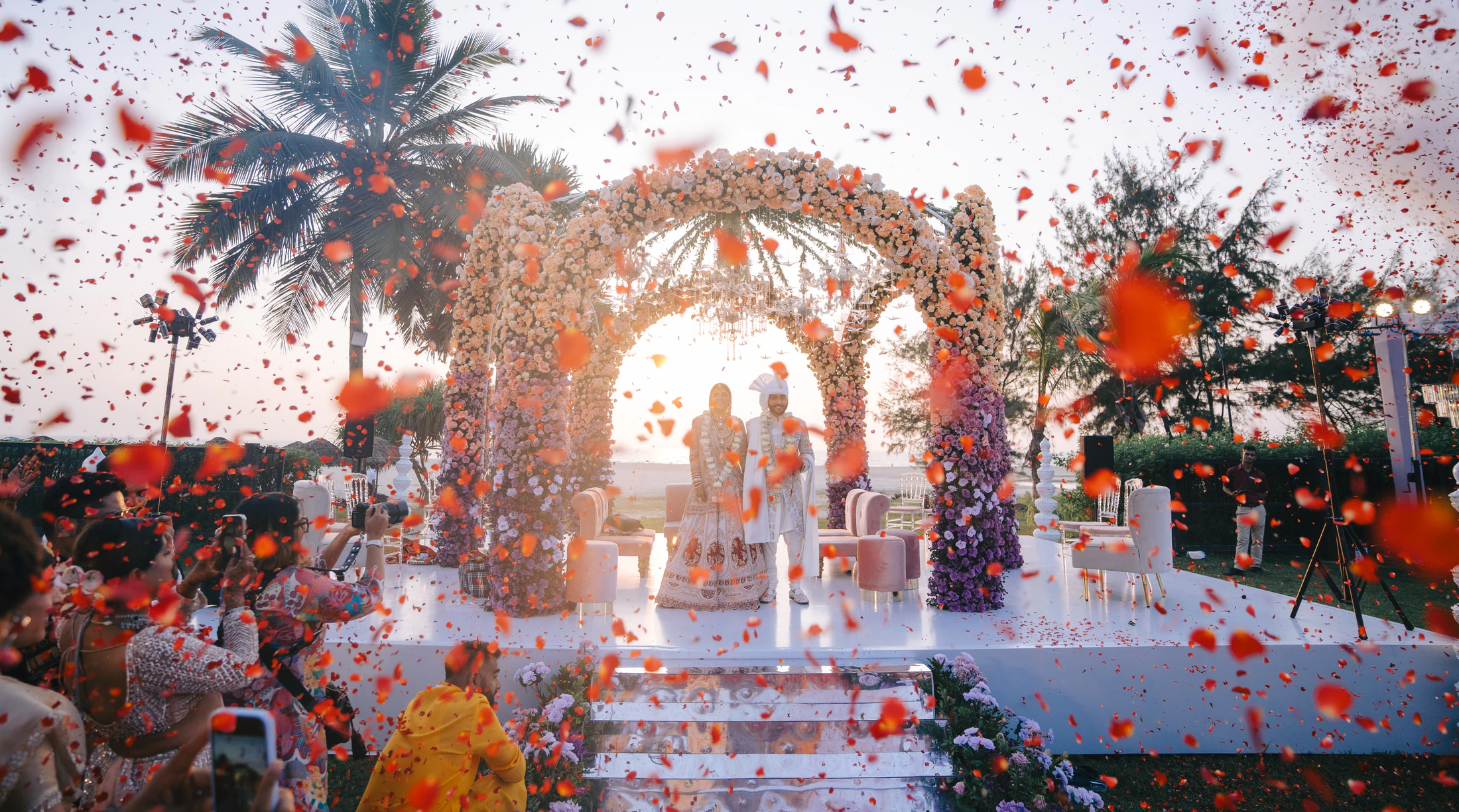
June 12, 2026By Elite Wedding Planning Team
The Sikh wedding ceremony — Anand Karaj, meaning blissful union — is one of the most spiritually anchored wedding traditions practised in India today. It centres on the Guru Granth Sahib as witness, not on spectacle, and its rituals carry meaning that has remained largely unchanged for centuries. For families planning a destination Sikh wedding at a Gurdwara in Goa, Udaipur, or Jaipur, or at an approved venue with a portable Guru Granth Sahib, understanding the ceremony's requirements is not optional — it determines whether the wedding can proceed at all.
We have planned Sikh weddings across India and internationally, and the single most common point of friction is the venue’s unfamiliarity with Anand Karaj requirements. This guide covers every ritual, every logistical consideration, and everything a couple and their families need to coordinate before the wedding week begins.
Understanding Anand Karaj: What Makes a Sikh Wedding Distinct
Anand Karaj is not a cultural performance. It is a religious ceremony governed by the Sikh Rehat Maryada (code of conduct), and it requires specific conditions: the presence of the Guru Granth Sahib, a Granthi to officiate, and a venue that meets Gurdwara standards or receives explicit approval. A beachfront lawn or a heritage courtyard may be beautiful, but if the Guru Granth Sahib cannot be installed with appropriate protocol — a raised platform, a canopy, a clean space free of footwear, and no alcohol on the premises — the ceremony cannot take place there.
Four principles anchor the ceremony:
- Equality: The bride and groom approach the Guru Granth Sahib as equals, seated side by side during the Lavan (the four wedding hymns). There is no kanyadaan, no giving away of the bride.
- Simplicity: The ceremony itself is understated. The focus is the scripture and the hymns, not the décor or the guest count.
- Community (Sangat): The congregation — family and guests — does not merely watch. They participate through prayer, hymn-singing, and the distribution of Karah Parshad (blessed sweet offering).
- Divine presence: The Guru Granth Sahib is treated as a living Guru. Every ritual orbits around it, and the protocols governing its installation, handling, and transport are non-negotiable.
Pre-Wedding Sikh Ceremonies
A Sikh wedding is not a single day. The ceremonies build across several days, each with its own significance and its own logistical demands.
Roka and Kurmai (Engagement and Formal Commitment)
The Roka is the informal family agreement — both sides meet, exchange sweets, and confirm the union. The Kurmai (also called Shagan) is the formal engagement, typically held at the bride’s home or a Gurdwara hall. The groom’s family visits with gifts (clothes, jewellery, sweets, a coconut, and money as shagan). Rings are exchanged, and an Ardas (prayer) may be recited. For destination weddings, the Roka often happens in the home city months earlier; the Kurmai may be merged with the destination events if families agree.
Chunni Chadai (Bridal Welcome)
The groom’s family places a red chunni (scarf) over the bride’s head and presents her with jewellery. It is the formal acceptance of the bride into the groom’s family and typically happens a week or two before the wedding. At a destination wedding, this is often scheduled on the first day of the wedding weekend, before the sangeet.
Maiyan and Vatna (Purification)
Turmeric paste (vatna) is applied to the bride and groom separately at their respective family gatherings, usually two or three days before the wedding. Yellow is the colour — yellow clothes, yellow paste, yellow flowers. The ritual signifies cleansing and preparation. At a destination wedding, families typically use adjacent hotel suites or villas and the paste is applied by close female relatives while traditional folk songs play.
Choora and Kalire (The Bangles)
The bride’s maternal uncle (mama) presents the choora — a set of red and white ivory or acrylic bangles. The bangles are first dipped in milk and then placed on the bride’s wrists. After the choora, the bride’s sisters and friends tie kalire — ornate hanging ornaments — to the bangles. The tradition of the bride shaking her kalire over an unmarried friend’s head (whoever a piece falls on is said to be next to marry) is a lighter moment in an otherwise solemn sequence. The choora is worn for at least forty days after the wedding, sometimes a full year.
Sangeet and Mehndi
The sangeet is the musical evening — traditional folk songs (suhaag), Bollywood numbers prepared by cousins, and increasingly, professionally choreographed family performances. The mehndi follows the next day or the same afternoon: intricate henna on the bride’s hands and feet, with the groom’s initials or a hidden motif worked into the design. At a destination wedding, the sangeet and mehndi are the two most logistically complex pre-wedding events — they require a stage, sound, and coordinated performances across multiple families who may be meeting for the first time.
The Anand Karaj: Step by Step
The ceremony runs approximately ninety minutes to two hours. Here is the sequence, and here is what a venue must provide for each step to work.
Milni (Introduction of Families)
The ceremony begins at the Gurdwara entrance with the Milni: designated male relatives from each side pair up (father to father, uncle to uncle, brother to brother), exchange garlands, and embrace. It is formal but often warm and sometimes competitive — relatives may be lifted or spun. This is the moment the two families become one sangam.
Installation of Guru Granth Sahib and Ardas
Guests remove their shoes, cover their heads (mandatory for everyone, regardless of faith), and enter the Darbar Sahib (prayer hall). The Granthi (Sikh priest) performs a brief Ardas — a standing prayer with folded hands — to invoke blessings for the ceremony.
Hukamnama (Divine Order)
The Granthi opens the Guru Granth Sahib at random and reads the first hymn on the page. This reading is considered the Guru’s guidance for the couple’s married life. The congregation sits and listens.
The Lavan (Four Wedding Hymns)
This is the core of the ceremony. The Lavan are four hymns composed by Guru Ram Das Ji. Each hymn describes a stage of spiritual union and married life. The Granthi recites each hymn; as it is sung, the couple rises and walks clockwise around the Guru Granth Sahib, completing one circumambulation per hymn. The groom leads, the bride follows, holding the groom’s scarf or sash. After the fourth and final circumambulation, the couple is married.
Anand Sahib, Ardas, and Karah Parshad
The congregation sings the Anand Sahib (the Song of Bliss), followed by a concluding Ardas. Karah Parshad — a warm semolina-and-butter sweet — is distributed to everyone present, a gesture of communal blessing.
Langar (Community Meal)
After the ceremony, the couple and their guests share langar — a simple vegetarian meal served in the Gurdwara hall. For destination weddings, the langar is often the logistical centre of the wedding day: seating 200 to 500 guests for a sit-down meal requires planning the serving line, the dietary restrictions, and the cleanup. Many families enhance the langar with additional catering while keeping the core dishes — dal, roti, sabzi, kheer — authentic.
Venue Requirements for a Sikh Destination Wedding
Not every beautiful venue can host an Anand Karaj. The requirements are specific and non-negotiable:
- Guru Granth Sahib installation: A raised, covered platform (palki sahib) in a clean, shoe-free space. The Granthi must be present at all times the scripture is installed.
- No alcohol or meat on the premises during the ceremony, and ideally for the entire wedding duration if the Guru Granth Sahib remains installed overnight.
- Head covering for all attendees: The Gurdwara provides rumalas (headscarves); for non-Gurdwara venues, the family must arrange these.
- Seated on the floor: Chairs are not permitted in the Darbar Sahib during the ceremony. Elderly guests who cannot sit on the floor may use low stools at the back.
- Approved Granthi: The officiant must be a practising Sikh authorised to perform Anand Karaj. The venue cannot provide a substitute.
Many couples planning a destination Sikh wedding choose a city with a well-established Gurdwara — Goa, Udaipur, and Jaipur all have functioning Gurdwaras that regularly host wedding ceremonies. The alternative is an approved secular venue: a hotel ballroom or heritage courtyard that meets the requirements and receives prior approval from the local Gurdwara committee. Our destination wedding planning guides cover Gurdwara-adjacent venues in each region.
Traditional Sikh Wedding Attire
The groom wears a sherwani or achkan in deep red, gold, cream, or pastel tones, with a churidar or trousers, a turban (pagri or safa), a kalgi (ornamental brooch) pinned to the turban, and a Sehra — a floral veil tied over the face by his sister before the ceremony. The Sehra is untied by the bride’s family during the Milni.
The bride wears a heavily embroidered lehenga or salwar kameez, traditionally in red with gold work, though modern brides increasingly choose pinks, oranges, and pastels. The red choora and gold kalire are the most recognisable elements. The bride also wears a nath (nose ring), maang tikka, and heavy earrings (jhumkas) passed down or bought for the occasion.
Guests are expected to cover their heads inside the Darbar Sahib — this applies to everyone regardless of faith. Women typically use a dupatta or chunni; men use a rumala or handkerchief. Communicate this clearly in the wedding invitation and the welcome information at a destination wedding, where many guests may not be familiar with Sikh customs.
Planning Tips for a Destination Sikh Wedding
- Confirm the Gurdwara or venue approval first. Do not book flights and hotel blocks until you have a confirmed Anand Karaj date and venue approval in writing. Some Gurdwaras require the couple’s marriage registration documents weeks in advance.
- Schedule the Anand Karaj for the morning. Tradition dictates the ceremony be held in the early hours — ideally before noon. For a destination wedding, this means the reception and evening events fall naturally into the same day without rushing.
- Arrange head coverings for guests. Order 200-300 basic rumalas or handkerchiefs and have them in baskets at the Gurdwara entrance. It costs very little and eliminates the most common guest anxiety.
- Plan the langar seating carefully. If 300 guests move from the ceremony to the langar hall, the serving line must be fast and the seating must accommodate elders who cannot sit cross-legged on the floor. A planner who has done langar logistics before is worth their weight here.
- Coordinate the choora and kalire with the photographer. These are some of the most photographed moments of a Sikh wedding — brief the photographer on the timing and the significance so the shots are deliberate, not rushed.
Frequently Asked Questions
Related reading for your planning:
- Wedding Planning in Goa: Complete Destination Guide — includes Gurdwara locations and approved venues for Anand Karaj
- Ultimate Destination Wedding Guide for Indian Couples — covers logistics for multi-day celebrations across India
- Wedding Vendor Selection Guide: How to Choose the Right Team — finding a Granthi, photographer, and caterer who understand Sikh ceremonies
For help planning a destination Sikh wedding — from Gurdwara coordination to venue approvals to langar logistics for 300-plus guests — speak with our planning team. We have coordinated Anand Karaj ceremonies across Goa, Udaipur, Jaipur, and Kerala, and we know which venues understand the requirements and which ones need walking through them.
Questions couples ask next
Yes, but with conditions. The venue must provide a clean, shoe-free hall where the Guru Granth Sahib can be installed on a raised platform with a canopy. No alcohol or meat can be served on the premises while the scripture is present. The venue must receive prior approval from the local Gurdwara committee, and an authorised Granthi must officiate. Many luxury hotels in Goa, Udaipur, and Jaipur have hosted Anand Karaj ceremonies and understand these requirements — but always confirm in writing before booking.
Private planning direction
Turn this guide into venue-fit options.
Share destination, month, guest count and budget range. Elite can help you understand venue fit, guest movement, decor scale, vendor coordination and wedding-week production before you commit.
Useful next pages
Plan Goa wedding