June 6, 2026By Elite Wedding Planning Team
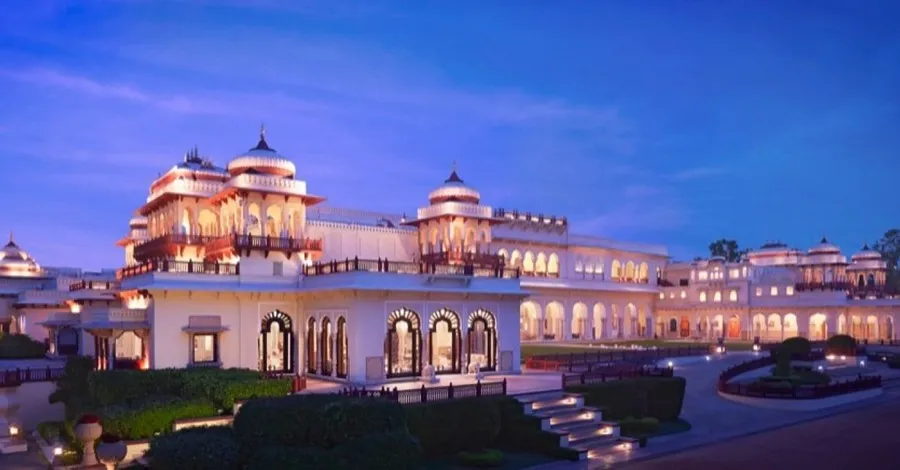
When couples say they want a royal Rajasthan wedding, most of them are picturing Rambagh Palace — even before they know the name. The pink sandstone facade. The carved jali screens. The sweeping Mughal gardens. The sense of walking into a place where history and celebration are the same thing.
Rambagh Palace is not just a hotel. For more than a century, it served as the royal residence of the Maharaja of Jaipur before it was transformed into one of India's most celebrated luxury properties under the IHCL Taj family of hotels. It earned the title of "Jewel of Jaipur" and has held it ever since.
For destination weddings in Jaipur, Rambagh remains the benchmark against which every other venue is measured. Newer luxury hotels have opened across the city. Some have larger capacity. Some have more contemporary design. But none has Rambagh's combination of authentic royal heritage, mature landscape, architectural grandeur and the particular quality of light that falls across its lawns at golden hour.
This guide covers everything you need to know before booking a wedding at Rambagh Palace: the event spaces, accommodation strategy, the royal baraat experience, the best season to celebrate, how to approach decor, how it compares with nearby alternatives and what working with Elite as your destination wedding planner looks like when Rambagh is your venue.
Why couples still choose Rambagh over newer alternatives
The luxury wedding market in Jaipur has grown considerably. Hotels like Fairmont Jaipur offer significant banquet capacity. Boutique palaces outside the city like Samode offer extraordinary intimacy. The question is not whether other options exist — they do, and some are excellent. The question is what Rambagh offers that they cannot.
Authenticity of heritage. Rambagh was a working royal residence. The architecture, the garden layout, the proportions of its spaces — these were designed for royal ceremony, not for commercial events. That difference is felt when you walk through the property and when guests arrive for a celebration.
The setting itself does the work. At many luxury venues, decor must carry the entire visual weight of an event. At Rambagh, the backdrop is already extraordinary. The pink Rajasthani sandstone, the ornate carved details, the mature gardens, the fountains — all of it works for the wedding before a single marigold is arranged.
Sense of place. International guests, NRI families and couples from metro cities often choose Rambagh because the property gives guests a genuinely Rajasthani experience. Not a contemporary hotel with Rajasthani motifs. The real thing.
Taj service standard. As part of the IHCL portfolio, Rambagh carries the service culture that the Taj brand is known for globally. For families who have experienced Taj properties before, this is a familiar and trusted standard for managing large wedding groups.
Event spaces at Rambagh Palace
Rambagh offers several distinct event spaces, each suited to different functions within a multi-day wedding celebration. All figures below are approximate — confirm exact capacities and current configurations with the hotel directly at the time of booking.
The Baradari
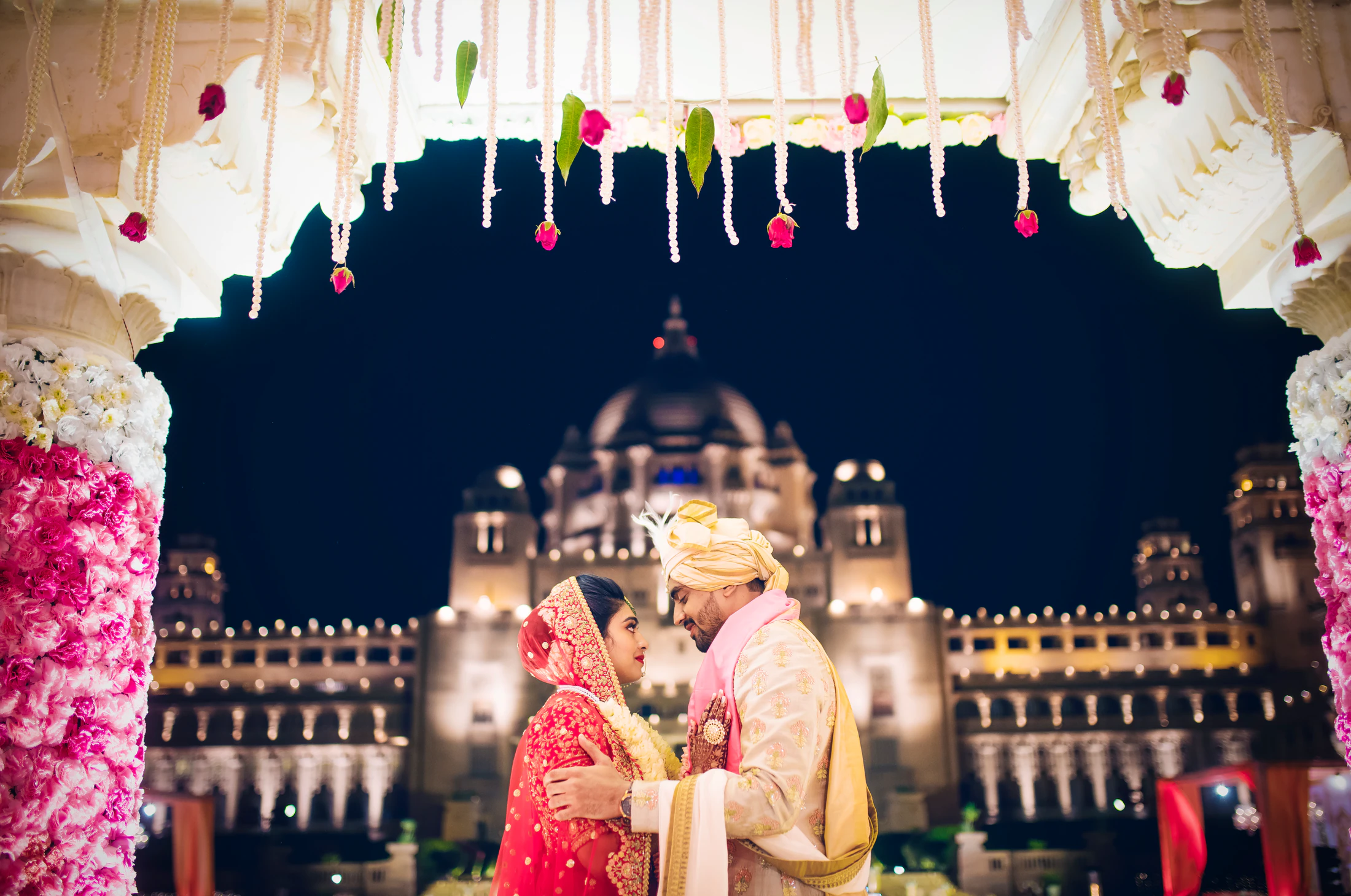
The Baradari is arguably the most photographed event space in Jaipur. This elegant outdoor pillared pavilion, open to the garden and sky, is defined by its graceful arches and classical proportions. It is the space most couples associate with Rambagh's visual identity.
For wedding ceremonies and evening receptions, the Baradari creates a frame that is difficult to replicate anywhere else. Approximately 300 to 400 guests can be accommodated depending on setup style. Evening lighting — both the hotel's ambient illumination and specialist wedding lighting — transforms the Baradari into something genuinely spectacular.
The outdoor nature of the Baradari means seasonal timing matters. November through February is when this space performs at its best. Cool evenings, clear skies and low humidity allow guests to move freely and linger outdoors.
Rajmahal Terrace
For more intimate events — a private family dinner, a pre-wedding sundowner, a small cocktail reception — the Rajmahal Terrace offers a rooftop setting overlooking the palace gardens. At approximately 100 to 150 guests, it is not designed for the full wedding gathering but works exceptionally well for curated, personal events within a larger wedding programme.
The terrace experience is about proximity and intimacy. Guests are closer together, the palace surrounds them on all sides and the garden below gives the setting its depth.
Rajput Room
For covered indoor dining, the Rajput Room is Rambagh's grand ballroom option. Approximately 400 guests can be seated for a formal dinner. The space retains the palatial character of the rest of the property — high ceilings, rich décor, classical proportions.
The Rajput Room becomes most important as a backup or as a deliberate indoor function choice. For couples planning a November or December wedding where outdoor events feel weather-secure, the Rajput Room can host a rehearsal dinner, a family lunch or a final reception with its own elegance intact.
Palace Gardens and Lawns
Rambagh's gardens are among its most valuable assets. Multiple lawns and garden sections give a planner genuine flexibility to spread a multi-day wedding celebration across the property without any single event overwhelming the space.
Pre-wedding functions — mehendi, haldi, a welcome morning gathering — can each find a distinct garden location that feels personal and separate rather than repetitive. This is important for a 3- to 4-day wedding programme where guests need each event to feel fresh.
The mature landscaping, the fountains, the symmetrical pathways and the palace facade as backdrop give garden setups at Rambagh a quality that purpose-built hotel banquet lawns simply cannot match.
Accommodation at Rambagh Palace
Rambagh Palace has approximately 78 rooms and suites in its inventory (this figure is approximate — verify the current count with the hotel as part of your booking discussions). The room types range from Palace Rooms through to the historic Royal Suite, with several category levels in between.
For a wedding, accommodation strategy matters enormously.
Full buyout vs partial room block
A full hotel buyout — where the entire property is reserved exclusively for the wedding party — is the dream scenario. It removes the possibility of outside guests sharing the space, gives the family complete control over all common areas, lawns and facilities, and creates a more exclusive, contained celebration.
However, buyouts at Rambagh are priced accordingly and require strong advance commitment across all room categories. For families genuinely committed to this route, discussions typically need to begin 18 to 24 months before the wedding date, especially for peak season (November through February).
A partial room block — reserving a significant portion of rooms for the wedding party while the hotel continues to accept other guests — is a more common arrangement. The trade-off is that some areas of the property will have non-wedding guests, which can affect the feel of certain spaces. Experienced planners manage this by working with the hotel on event-space exclusivity terms even when the room block is partial.
Room strategy for a 200-guest wedding
For a 200-guest celebration where the majority of guests are travelling to Jaipur from other cities or countries, a rough working assumption is that many guests will require rooms. Given that some guests will travel as couples and share rooms, and some will be local Jaipur guests who do not require accommodation, a typical room demand for a 200-guest wedding might range from 60 to 90 rooms depending on the specific guest profile.
With approximately 78 total rooms in the property, this means a 200-guest wedding requiring substantial accommodation will likely need to either pursue a full buyout (if numbers work) or plan for overflow accommodation at nearby luxury properties in Jaipur — with regular transfers between the overflow property and Rambagh.
This overflow planning is an area where working with an experienced planner makes a material difference. Managing guest transport, ensuring VIP guests are accommodated on-site, and coordinating arrival and departure across multiple properties requires careful advance logistics.
The Royal Suite
The Royal Suite at Rambagh is where the couple or the immediate family typically stays during the wedding. It is a historic space and functions as the emotional and ceremonial anchor of the property during a wedding. For the bridal party, the suite and its adjacent spaces form the getting-ready environment that will appear in every preparation photograph.
The royal baraat at Rambagh Palace
A Jaipur baraat is one of the great spectacles of Indian wedding celebrations. The city's wide roads, the architectural grandeur of the surroundings and the tradition of elaborate processional entries make for a baraat experience that is qualitatively different from what is possible in a cramped urban setting.
Elephant and horse processions
Rajasthan has a long tradition of elephant-led baraats. Rambagh's entrance — a grand gateway that announces arrival into the palace grounds — provides the perfect theatrical frame for a ceremonial procession. The road approach and entrance gate create a natural stage.
Horse processions, with the groom mounted on a decorated horse accompanied by dhol players, family dancers and family members, are the most common format. The entry through Rambagh's gates, with the palace illuminated in the background, creates one of the most photographed moments in Indian destination weddings.
Elephant arrangements in Rajasthan are subject to current regulations and availability. These need to be confirmed with significant advance notice and require proper permits. An experienced local team — which Elite coordinates — handles these arrangements to ensure everything is in order.
What Elite handles for baraat coordination
Baraat coordination at a venue like Rambagh involves far more than booking a horse. It requires:
- Route planning from the groom's side staging area to the palace entrance
- Sound system and dhol coordination along the route
- Photography and videography positioning for the procession
- Crowd management to keep the procession moving and photogenic
- Timing coordination with the venue's entry-gate ceremony
- Lighting for evening baraats
- Animal welfare compliance for any animal-involved processions
- Contingency planning for any last-minute route or timing changes
The baraat is often the most emotionally charged event of a Jaipur wedding. It sets the energy for everything that follows. Getting it right requires advance planning and on-the-day coordination from someone who has managed this at Jaipur venues before.
Seasonal guide: when to hold your Rambagh wedding
November to February: the ideal window
The winter months are unambiguously the best season for an outdoor Rajasthan wedding. Temperatures during the day are pleasant and evenings cool down to genuinely comfortable conditions. In December and January, evenings can feel cold — 10°C to 15°C in Jaipur's winter — which means outdoor evening events may require heaters and shawl arrangements for guests.
November and February are often considered the sweet spots within this peak season. The weather is comfortable across both day and evening, the light is beautiful and the full garden experience at Rambagh is accessible without the cold-evening logistics of December and January.
Peak season also means premium pricing and limited availability for marquee dates. For a Rambagh wedding in December or early January, discussions with the hotel typically need to begin 18 months or more in advance.
October: the early-season option
October weddings at Jaipur are viable, especially from mid-October onward. The monsoon has retreated. Evenings are warmer than peak season but manageable — typically 20°C to 25°C by late evening. The gardens are lush from the monsoon rains, which creates a different and genuinely beautiful setting.
October offers better availability and more flexibility on commercial terms than the December-January peak. For couples who want Rambagh but need more negotiating room, October is worth serious consideration. The trade-off is that late evenings can still feel warm for guests who are not acclimatised to Rajasthan's climate.
Summer (March to May): an honest assessment
Rajasthan in summer is genuinely hot. By late March, daytime temperatures in Jaipur can exceed 35°C. April and May see temperatures climbing to 40°C and above with low humidity in the pre-monsoon phase.
Outdoor evening ceremonies remain technically possible in early March. From April onward, any outdoor element is uncomfortable for guests and potentially damaging to elaborate decor. Indoor-only weddings at Rambagh are possible year-round given the quality of its internal spaces, but the full expression of what makes Rambagh extraordinary — the gardens, the outdoor Baradari, the evening baraat — is significantly constrained in summer.
For families with genuine flexibility on dates, the October-to-February window is strongly recommended.
Decor at Rambagh Palace: working with the architecture
The architecture as your starting point
Rambagh's pink sandstone exterior, intricate carved jali screens and formal Mughal garden layout provide a strong visual foundation that most contemporary wedding venues simply do not have. This is an asset — but it also sets clear parameters for what decor should and should not try to do.
Decor that works with Rambagh's architecture tends to feel warm, layered and historically resonant. Decor that fights it — contemporary geometric structures, highly industrial materials, colour palettes that clash with the soft pink and warm ochre of the stonework — can feel incongruous in a way that is visible in every photograph.
Marigold vs exotic flower debates
There is an ongoing aesthetic debate in Indian wedding decor between traditional marigold-heavy arrangements and more international floral styles using garden roses, peonies, orchids and tropical foliage.
At Rambagh, both approaches can work — but they work differently. Marigold-led decor with warm saffron, deep red and golden tones feels deeply authentic in a Rajasthani palace setting. It references the visual vocabulary of the architecture itself.
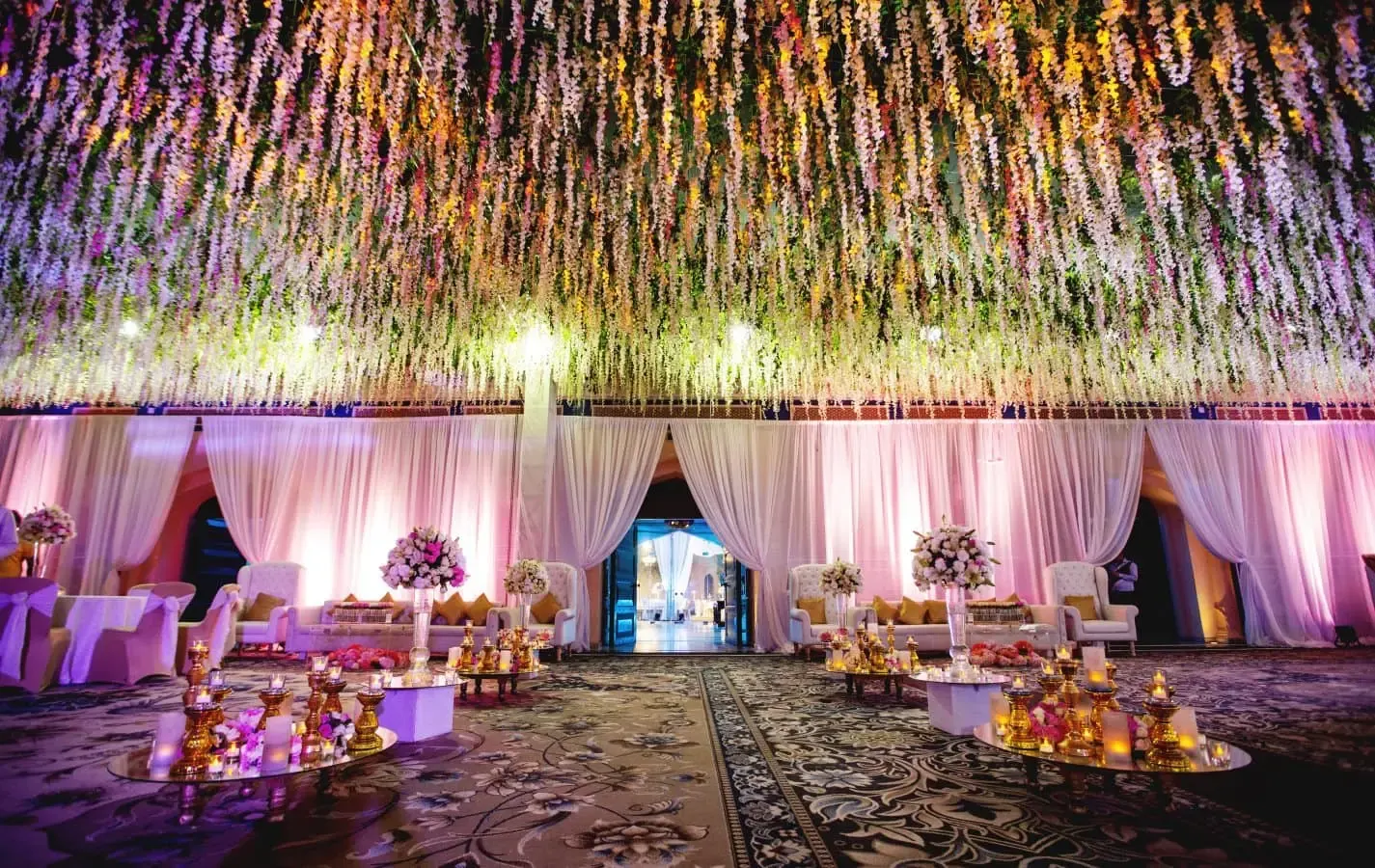
More internationally influenced florals — the soft blush, white and green palette that many contemporary couples prefer — can also look beautiful at Rambagh, but the design has to be more deliberate to maintain coherence with the setting. Pale, muted tones against the warmth of the pink stone require more considered lighting to avoid looking washed out in photographs.
Large floral mandaps at Rambagh
The floral mandap is often the centrepiece of a Rambagh wedding ceremony. Given the scale of the property and the palatial proportions, mandap structures at Rambagh need to hold their own visually. An undersized or under-decorated mandap will look lost.
Some of the most memorable mandap designs at properties like Rambagh are those that draw from the architecture's own vocabulary: arched forms, columns, carved detail translated into floral arrangements, warm colour palettes. The mandap should feel like it belongs to the palace, not like it was brought in from outside.
Rambagh vs nearby alternatives: an honest comparison
Fairmont Jaipur
Fairmont Jaipur is a strong contemporary luxury venue with larger banquet capacity than Rambagh. For very large guest counts — above 500 guests — Fairmont is often a more practical choice from a pure capacity perspective. Its event spaces are designed for modern weddings.
What Fairmont cannot offer is Rambagh's heritage authenticity. It is a beautifully designed contemporary hotel with Rajasthani motifs. Rambagh is an actual former royal residence. For families where the heritage context is central to their vision, Fairmont is a different product — excellent in its category, but not a direct substitute.
Samode Palace
Samode Palace is located outside Jaipur, approximately 40 kilometres from the city. It is a genuine Rajput palace, smaller and more intimate than Rambagh, with extraordinary internal frescoes and courtyard spaces.
For smaller guest counts — 100 to 200 guests — and for couples who want an even more exclusive and historically immersive setting, Samode is worth serious consideration. The trade-off is its distance from Jaipur's main transport infrastructure, which complicates guest logistics.
Jai Mahal Palace
Jai Mahal Palace is another IHCL Taj property in Jaipur, also a heritage palace. It competes directly with Rambagh in terms of heritage positioning but is generally considered a step below Rambagh in prestige and setting quality. For families who want a Taj heritage palace in Jaipur, Rambagh remains the flagship choice. Jai Mahal is the consideration when Rambagh dates are unavailable or when budget parameters differ.
Cost guidance: what to expect at Rambagh
Rambagh Palace sits at the ultra-premium end of the Jaipur wedding market. All figures below are indicative ranges only — actual costs depend on date, guest count, event structure, specific packages and current pricing at the time of inquiry.
Venue and accommodation: Room rates at Rambagh during peak wedding season are at the higher end of the Jaipur luxury market. A full-property buyout for a 3- to 4-day wedding celebration represents a significant investment. Partial room blocks with venue event-space fees are a more common arrangement.
Catering: Rambagh operates its own catering and has specific policies regarding outside catering vendors. Catering costs for a multi-day celebration with multiple functions represent a substantial portion of total wedding cost.
Production and decor: For a wedding at a property with Rambagh's scale and reputation, decor and production budgets need to be proportionate. Mandap construction, floral arrangements across multiple functions, lighting design and stage production are typically a significant line item.
Indicative total spend for a 3-day, 200-guest wedding at Rambagh covering accommodation, catering, decor, production and associated costs would sit in a range that places it clearly in the premium tier of destination weddings in India. Elite can provide detailed guidance on current indicative ranges during a planning consultation.
How Elite works with Rambagh Palace
Advance bookings and date strategy
For the most sought-after dates — the clear winter weekends in November, December and January — demand at Rambagh runs 18 months or more ahead. Families who approach us with these dates in mind need to begin venue conversations and hold dates significantly in advance of their wedding week.
Elite's relationship with Taj properties and our booking history helps navigate the conversation effectively. But no planner can manufacture availability for dates that are genuinely committed. Starting early is the most important thing we tell families.
Vendor coordination
Rambagh, as a Taj property, has specific policies regarding vendors — which external vendors are permitted, which vendor categories are managed in-house by the hotel, and what the coordination protocol is for bringing in specialist wedding suppliers. Elite works within these frameworks, coordinating our decor, production and entertainment partners appropriately.
Understanding these policies in advance — before signing contracts with vendors who may not have Taj property access — is an area where experienced planners protect families from expensive mistakes.
On-the-day and week-of management
A multi-day Rambagh wedding involves coordinating between the hotel's own events team, our decor and production vendors, entertainment suppliers, priest and ritual coordination, family logistics and guest management. Elite's role is to be the single point of coordination across all of these — so that the hotel team manages the hotel, vendors manage their technical execution, and the family experiences the celebration rather than managing it.
Ready to plan your Rambagh Palace wedding?
A wedding at Rambagh Palace is one of the most extraordinary celebrations in Indian wedding planning. It is also one that requires more advance planning, more careful commercial navigation and more experienced on-the-ground coordination than most venues.
Elite has worked in Jaipur across multiple seasons, multiple wedding formats and multiple venue types. We understand what it takes to deliver a Rambagh wedding at the level that the setting deserves.
Plan My Rambagh Wedding — talk to our team about your dates, your vision and how we can make Rambagh work for your family.
Questions couples ask next
Rambagh Palace can accommodate approximately 300 to 400 guests in its outdoor Baradari space, and around 400 guests for a seated dinner in the Rajput Room ballroom. For the full garden and multi-space setup, total capacity across all event areas is larger. Confirm exact current capacities with the hotel at the time of booking, as configurations and setup styles affect usable numbers.
Private planning direction
Turn this guide into venue-fit options.
Share destination, month, guest count and budget range. Elite can help you understand venue fit, guest movement, decor scale, vendor coordination and wedding-week production before you commit.
Useful next pages
Plan Jaipur wedding
From reading to a real wedding plan.
Continue planning