Complimentary Planning Guide · 2026 Edition
The Elite Guide to Planning a Destination Wedding in India
This is the working playbook behind 220+ celebrations across 60+ destinations since 2011 — how to choose your city, how venue deals are actually negotiated, where the money really goes, and where weddings go wrong.
It is written by our planning team, not a content desk. Read it end to end, or jump to the section you need.
Leave your details and we'll send a save-able edition of this guide — and a planner will reply personally if you have a date or destination in mind. No newsletters.
01 · The framework
Choosing your destination
Most couples start with a place they love. Planners start with four questions — because the right destination is the one that survives all four, not the one with the prettiest photographs.
1. Who is actually coming?
Map the age span and mobility of your list before anything else. Grandparents and young children reward single-resort stays and short transfers — Goa, Jaipur, Dubai. A younger crowd will happily take a connecting flight for Udaipur’s lakes or a Thai island.
2. How much travel friction can your list absorb?
Count the legs from door to venue, not the airfare. One direct flight and a short drive keeps RSVPs high; two connections and a ferry quietly reshape your guest list for you.
3. Does the weather window fit your date?
India’s prime season runs October to March. Rajasthan is dependable across it (carry warmth for December–January evenings), Goa and Kerala are at their best November to February, Dubai November to April, Thailand November to February. Outdoor ceremonies should always carry a built-in time buffer.
4. What shape does your budget take there?
The same budget buys different weddings in different places. A palace city puts money into the venue itself; a beach destination frees more for guest experience and production; an international island trades venue value against airfares. Decide which shape you want before you shortlist.
A quick scan of the destinations we plan most
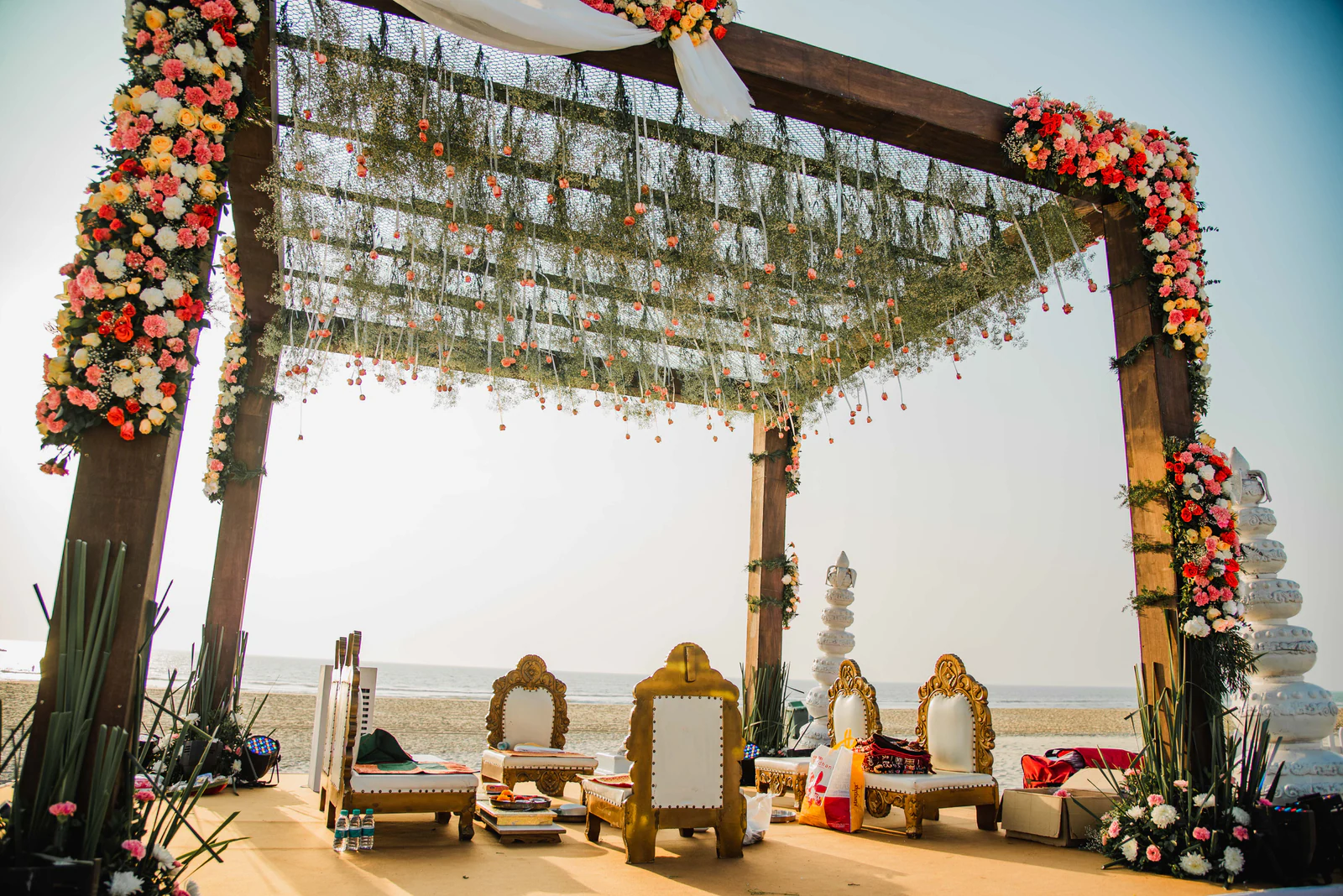
Goa — Beach resorts with direct flights from every metro — the easiest destination for a mixed-age guest list. Best November to February.
Udaipur — Palace weddings on the lakes and the most photographed backdrop in India. Fewer direct flights, so arrivals need planning; evenings turn cold in December and January.
Jaipur — The most accessible of the palace cities — heritage venues with metro-grade connectivity and deep hotel inventory. Reliable October to March.
Jodhpur — Fort-and-palace drama with Mehrangarh on the skyline. Suits couples who want Rajasthan at its most cinematic.
Jaisalmer — Golden sandstone and desert evenings. Remoteness is the feature — bring guests who treat the journey as part of the celebration.
Kerala — Backwaters, greenery and a quieter register of luxury. Strongest for intimate, unhurried celebrations between November and February.
Dubai & Abu Dhabi — Visa-light, nonstop flights, ballroom polish and desert venues. The international option that asks the least of your guests. November to April.
Thailand — Phuket & Koh Samui — Island resorts where five-star service meets genuine value, and travel for Indian guests is famously easy. November to February.
Bali & the Maldives — The longest travel and the strongest privacy — built for smaller, design-forward celebrations rather than large family lists.

02 · The commercial heart of the wedding
How venue deals actually work
The venue contract is the single biggest commercial decision of the wedding, and it is negotiated in ways most couples never see. This is the part of the guide people pay planners for — so here it is in plain language.
Rooms are where resorts make their money
A destination wedding looks like an event; to the hotel it is occupancy. The lawn fee and banquet rental are the visible numbers, but the revenue manager is judged on room nights sold.
That is your leverage. A committed room block — guaranteed nights, in writing — is the thing the property actually wants, so venue fees, F&B rates and access charges are negotiated against it, never in isolation.
Couples who book the venue first and “sort rooms later” have given the leverage away before the conversation begins. Bring the block to the first meeting. Our room-block guide covers the mechanics in detail.
The calendar is half the negotiation
A Saturday in peak season needs no help selling itself; a Tuesday-to-Thursday celebration, or a date in the shoulder weeks either side of peak, changes the entire commercial conversation. The same wedding moved by three days can be negotiated very differently.
If your dates are flexible, say so early — flexibility is currency. If they are fixed by muhurat, accept that the calendar lever is spent and work the others harder.
Buyout or partial buyout — the real maths
A full buyout prices the entire room inventory, whether or not you fill it. In return you control everything: every key, every public space, the pool at midnight, the sound desk, the timings. No strangers at breakfast, no other event on your dates.
A partial buyout pays only for what you use — but you share the property, accept tighter curfews, and live with other guests at the edges of your photographs.
The threshold insight: once your room block approaches most of a property’s inventory, ask for the wedding priced both ways. The step up to a full buyout is often smaller than couples expect — and what it buys is total control. This is why smaller resorts filled completely so often beat half-occupied marquee hotels.
What is negotiable — and what rarely is
Usually negotiable
- Venue and banquet fees — the headline number moves most when a committed room block sits behind it
- F&B per-plate rates, menu inclusions and live-counter pricing
- Corkage, bottle policies and bar structures
- Outside-vendor access fees for decorators, caterers and photographers
- Power, generator and rigging charges
- Early check-in and late check-out for the room block
- Suite upgrades for parents and the couple
- Additional setup and rehearsal days at reduced or waived cost
Rarely moves
- Peak-date room rates — a November-to-February Saturday sells itself, with or without your wedding
- Taxes and statutory levies
- Sound curfews and licensing cut-offs set by local authorities
- Brand-mandated vendor and safety rules at some hotel chains
Which desk you reach changes what is possible
Large hotels sell group business through more than one door. The MICE desk thinks in corporate logic — room nights, F&B minimums, packaged rates; the weddings desk thinks in event logic — venue fees, décor access, function timings.
The same property can offer different flexibility depending on which desk owns your file. Part of a planner’s craft is simply knowing which door to knock on at which hotel — and when to move the file.
Why repeat business gets better terms
A couple is, commercially, a one-time client; an established planning practice returns to the same properties season after season. Venues price that future pipeline into present terms — priority date holds, gentler attrition, protected rates, concessions a first-time enquiry is never offered.
This is the least visible part of a planner’s fee, and usually the part that pays for itself first. It is also why the planner should be engaged before the venue is signed, not after.
Before you sign — contract hygiene
Attrition terms on the room block, price-escalation protection, the deposit and payment schedule, force-majeure language, and overtime rates for functions that run past curfew — all agreed in writing before signature, none of them after.
03 · The honest arithmetic
Budget reality — where the money goes
Every destination wedding budget, at every scale, resolves into four big movements. The venue and its room block form the largest single commitment. Production and décor come next — stages, lighting, florals, structures.
Food and beverage runs close behind, scaling directly with guest count and bar policy. Travel and guest logistics — transfers, hospitality desks, welcome programmes — complete the picture, with photography, entertainment and outfits sharing what remains. Knowing the shape matters more than any percentage: guest count multiplies three of the four buckets at once.
The five planning bands we work in
These are frames for decision-making, not price lists — two weddings in the same band can look entirely different depending on where the couple concentrates value.
Ultra Luxury — ₹3–5 Cr+
Full property buyouts, multi-day production with custom structures, international entertainment and a guest experience managed to the minute.
Luxury — ₹1–2 Cr
Five-star venues with partial or full buyouts, two to three days of functions, strong design and production, and a professionally run travel desk.
Mid-range — ₹50 L–1 Cr
Boutique resorts or a tighter guest list at a marquee destination — the band where prioritisation decides everything.
Intimate celebration — under ₹50 L
A focused guest list, one exceptional venue and design concentrated on a single evening rather than spread across four.
Prefer to discuss
Dual-city celebrations, international guest majorities and unusual briefs rarely fit a band — these begin with a conversation.
The classic hidden costs
None of these are exotic; all of them are forgotten regularly. Budget for them on day one and the final fortnight holds no surprises.
- GST and service charges layered on nearly every line
- Generators, power distribution and rigging for outdoor productions
- Overtime triggered by sound curfews and late-running functions
- Vendor rooms, meals and travel — a real line at remote venues
- Tastings, makeup trials and design mock-ups
- Transporting décor to remote or island venues
- Weather-contingency structures that you hope never to use
- Guest-count creep in the final fortnight
- Currency movement on international venue contracts
04 · The working calendar
The 12-month timeline
Twelve months is comfortable; eighteen is wise for palace and island venues in peak season, which are reserved furthest ahead. Compressed timelines are workable — they simply spend money where time has run out.
- Months 12–11
Agree the brief and the budget band. Shortlist two or three destinations against your guest profile. Engage your planner now — before any venue is signed.
- Months 10–9
Site visits, venue negotiation and contract. Lock the date, sign the room block, and put attrition and overtime terms in writing.
- Months 8–7
Design direction and décor partner confirmed. Photography and film booked. Save-the-dates out so guests can plan travel.
- Months 6–5
Entertainment and artists confirmed. Menus drafted and tastings scheduled. Guest list handed to the travel desk.
- Months 4–3
Invitations out and RSVPs tracked weekly. Outfit fittings under way. Function-by-function flow agreed with the venue.
- Month 2
Final guest-count windows agreed. Seating, room allocations and vendor call-sheets drafted. The weather plan B is now production-ready, not theoretical.
- Month 1
Minute-by-minute schedule issued. Arrival manifests, welcome kits and the concierge group set up. Rehearsals where they matter.
- Wedding week
Setup days run by the production team. Parents are shielded from logistics entirely — that is what the planning fee bought.
05 · What guests remember
Guest experience is the real luxury
Ask anyone what they remember from the best wedding they attended. It is rarely the centrepieces — it is how looked-after they felt. The logistics below are where that feeling is manufactured.
Arrivals set the tone
A managed arrival manifest, a named greeter at the airport, a clean transfer fleet and a room that is ready. The first hour decides how the whole weekend is judged.
A welcome desk and a kit worth keeping
One physical desk in the lobby, staffed at arrival windows, with the schedule, local essentials and a human answer to every question — it removes more friction than any décor line ever will.
A WhatsApp concierge group, run properly
One broadcast group, planner-administered, announcements only — timings, dress notes, transport calls. Guests get certainty without two hundred people debating in one thread.
Pace the weekend like a host, not a producer
One anchor event per half-day with genuine gaps between. Rest is part of the design — guests who napped at four dance at midnight.
Parents’ comfort is a planning line, not an afterthought
Seating with backs, lift access checked, quiet rooms near the action, dinner served early for elders, and a single point of contact so parents host instead of manage. Departures deserve the same care as arrivals.
06 · The direction of travel
What’s current in 2026
These are not predictions — they are the patterns leading planning and design practices worldwide are converging on, and what we are building into our own weddings this season. The full list lives in our 2026 trends guide.
Locally grown, seasonal florals
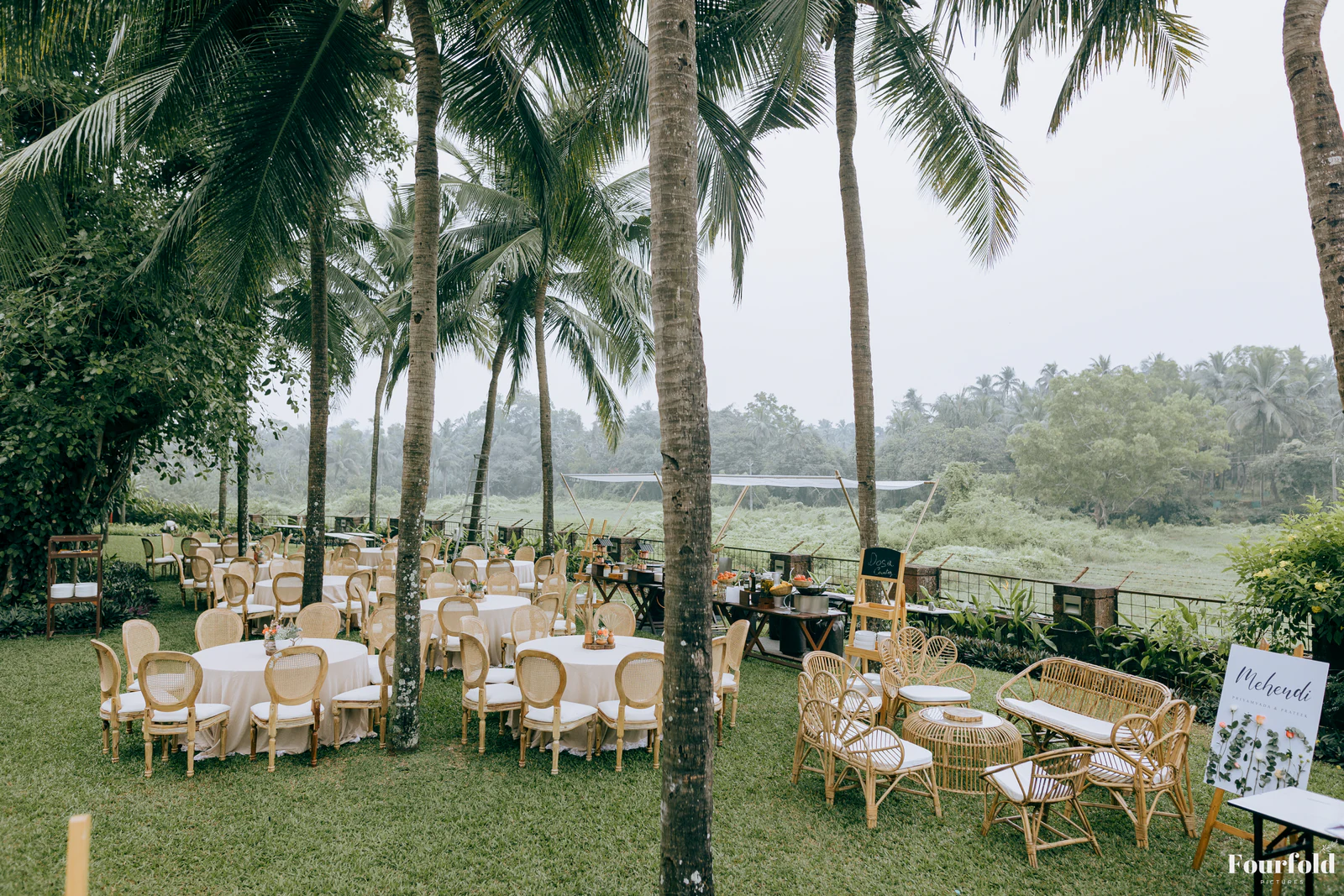
Sustainability has moved from talking point to design brief. Locally sourced stems and reusable installations now read as more considered — and travel better — than imported walls of bloom.
Smaller lists, longer celebrations
The shift is from one enormous night to three curated days with the people who matter. Multi-day guest experiences with a tighter list outperform scale almost every time.
Editorial photography over posed coverage
Couples are commissioning photographers who shoot like magazine editors — movement, candour and atmosphere over line-ups and staged smiles.
Tech-quiet ceremonies
Phones down for the vows, one shared gallery afterwards. The tech-quiet ceremony has become a marker of confidence: the moment is the point, not the broadcast.
Regional menus as the centrepiece
Heritage recipes, local chefs and produce from the destination itself. A Kerala sadya or a Rajasthani thali, done seriously, now outranks a generic continental spread.
Dual-city celebrations
A ceremony at home for the wider community, a destination celebration for the inner circle. Two events, two registers — and a far calmer guest list at each.
07 · Candidly
Mistakes we see every season
Different couples, different cities, the same eight errors. Every one of them is avoidable in month twelve and expensive in month two.
- 01
Signing the venue before engaging a planner
The contract is where experience pays for itself. Once it is signed, most of the leverage in this guide is gone.
- 02
Building the guest list after the budget
Guest count drives rooms, F&B, transport and production simultaneously. Decide the list and the band together, or one will quietly break the other.
- 03
Treating the room block as admin
The block is your single biggest bargaining chip, not a spreadsheet chore. Negotiate everything else against it.
- 04
A weather plan with no production value
If plan B is a sad ballroom nobody designed, it is not a plan — it is a penalty. The contingency must be built to the same standard as the original.
- 05
Over-programming the weekend
Back-to-back functions exhaust guests by day two. One anchor event per half-day, with genuine gaps, is what actually feels luxurious.
- 06
Ignoring sound curfews until the sangeet
Every destination has a licensing reality. Discover it during negotiation, not at 10:40 pm with a full dance floor.
- 07
Spending on the ceremony, starving the arrival
Guests form their impression in the first hour — the transfer, the welcome, the room. Money spent there is remembered longer than one more décor layer.
- 08
Letting saved images set the budget
Reference boards are useful for direction, dangerous for arithmetic. A look photographed in another climate, at another scale, rarely costs what you hope.
This guide is maintained by the planning team at Elite Wedding Planner — founders Sujay Pathak, Ruchita Pathak and Aloha Mehta — drawing on 220+ weddings produced across 60+ destinations since 2011.
Planning one of your own?
Elite accepts a limited number of weddings each season. Check whether your date is open, or begin with a private consultation.
Prefer to speak? Office: +91-8169255519
Keep reading
Trending guides from the journal
The most-read companion pieces to this guide — costs, comparisons, venues and this season’s direction.
Costs
Destination Wedding Cost in India 2026: Complete Budget Guide & Calculator
Read the guide →Logistics
Hotel Room Block for Destination Weddings: Complete Guide
Read the guide →Destinations
Goa vs Udaipur: Choosing Your Perfect Indian Destination Wedding
Read the guide →Trends
26 Wedding Trends for 2026: The Definitive Guide to Destination Wedding Trends
Read the guide →Venues
Top Palace Wedding Venues in Udaipur (2026 Guide)
Read the guide →Venues
Best 5-Star Wedding Venues in Goa 2026: What Families Should Check Before Booking
Read the guide →